Malaria on Safari: What Official Guidance Says
This is general information gathered from official sources, not medical advice. This page deliberately names no antimalarial drug and recommends no course of action. Whether you need malaria prophylaxis, and which option is appropriate, depends on your itinerary, your medical history and other medicines you take — it is a decision for a travel health professional. Consult a travel clinic or your own country's official travel health service, such as the CDC or the UK's NaTHNaC TravelHealthPro, well before departure.
Which safari areas are malaria risk areas?
Malaria risk on safari is regional and seasonal, not national. Several of the best-known safari destinations carry year-round risk; several others carry effectively none, which is why the question "is safari safe with children" often turns on which reserve rather than which country. The summary below is drawn from NaTHNaC country pages and CDC destination pages, accessed September 2026.
| Country | What the official sources say | Seasonality |
|---|---|---|
| Tanzania | High risk below 1,800m, including Zanzibar. No risk above 1,800m. | Year-round below 1,800m |
| Kenya | High risk generally; very low risk in Nairobi and the highlands above 2,500m. | Year-round |
| Uganda | High risk throughout the country. | Year-round |
| Rwanda | High risk throughout the country. | Year-round |
| Zambia | High risk throughout the country. | Year-round |
| Zimbabwe | Year-round risk in the Zambezi valley. Below 1,200m, high risk November–June and low risk July–October. Very low risk in Harare and Bulawayo. | Strongly seasonal outside the Zambezi valley |
| Botswana | Northern half, including the Okavango Delta: high risk October–May, low risk June–September. Southern half: very low risk year-round. | Strongly seasonal |
| Namibia | Kavango East, Kavango West and Zambezi (Caprivi): high risk year-round. Kunene, Omusati, Oshana, Ohangwena, Oshikoto, Omaheke, Otjozondjupa: high risk December–April, low May–November. Remaining areas including Windhoek and the Namib: very low. | Strongly seasonal in the north-centre |
| South Africa | High risk in low-altitude Mpumalanga and Limpopo bordering Mozambique, Eswatini and Zimbabwe, including Kruger National Park. Lower risk in far north-eastern KwaZulu-Natal. No risk in the rest of the country. | September–May; June–August very low risk |
| Zanzibar | Included by NaTHNaC in the high-risk band below 1,800m — it is not a malaria-free beach extension. | Year-round |
Which safari destinations are low or no risk?
Several genuinely popular safari regions fall outside malaria transmission areas according to official sources.
- The South African Cape and Eastern Cape. South Africa's National Institute for Communicable Diseases describes three malaria-endemic provinces — northeastern Limpopo, eastern Mpumalanga and northern KwaZulu-Natal. The Western Cape and Eastern Cape are not among them, and CDC's South Africa page lists no malaria transmission for Cape Town, the Western Cape or the Eastern Cape. This is why Eastern Cape reserves are routinely described as malaria-free safari options.
- Much of Namibia. NaTHNaC places Windhoek and the desert areas including Sossusvlei and the Namib in the "very low risk" category, with bite avoidance only. Etosha, however, lies mainly within regions NaTHNaC classifies as seasonally high risk from December to April.
- The southern Kalahari and southern Botswana. NaTHNaC places the southern half of Botswana in the very low risk category year-round, in contrast to the Okavango and the north.
- High-altitude East Africa. NaTHNaC records no risk above 1,800m in Tanzania and very low risk in Nairobi and Kenyan highlands above 2,500m. Note this affects specific high-altitude points rather than whole itineraries — the Ngorongoro crater rim sits high, but the drive in and out does not.
Two cautions. "Low risk" and "no risk" are not the same category in these classifications, and the boundaries are drawn by altitude and district, not by park gates — a lodge a short drive from a low-risk town may sit in a risk area. Verify the specific reserve, not the region.
Does the time of year change the risk?
Substantially, in southern Africa. Transmission there is tied to the rains and the warm months, which is why NaTHNaC gives Botswana, Namibia, Zimbabwe and South Africa split seasonal classifications while giving Uganda, Rwanda and Zambia year-round ones. South Africa's risk season runs September to May, with June to August described as very low risk — which overlaps neatly with the dry-season months many people choose for game viewing. In equatorial East Africa the seasonal swing is far less pronounced and risk is treated as year-round.
Seasonality reduces risk; it does not remove it, and official sources classify the low-risk months as low rather than nil.
What do CDC and WHO say about prophylaxis?
Both bodies treat preventive medication as a clinical decision rather than a blanket rule. CDC's position for risk areas is that "CDC recommends that travelers going to certain areas of [the destination] take prescription medicine to prevent malaria," with the specific areas listed per country. NaTHNaC frames prevention as the ABCD approach: Awareness of risk, Bite prevention, Chemoprophylaxis where appropriate, and Diagnosis without delay.
Both list more than one drug option for the region, and both attach conditions — some are unsuitable in pregnancy or for young children, some require testing beforehand, some interact with common medications, and start and stop dates differ, with some needing to begin weeks ahead and continue for four weeks after you leave. This page names none of them deliberately. Which option suits you, and whether you need one at all for a low-risk itinerary, is the judgement a travel clinic exists to make. NaTHNaC notes that antimalarials may be considered even in lower-risk areas for people at higher risk of severe malaria — including pregnancy, infants, older travellers, and those immunosuppressed or without a functioning spleen.
What does official guidance say about avoiding bites?
Bite avoidance is recommended in every risk category, including the areas where no medication is advised. CDC notes that "peak biting activity for Anopheles species tends to be during the night or evening hours" — the malaria mosquito is a dusk-to-dawn biter, which maps directly onto sundowners, dinner and the night in camp.
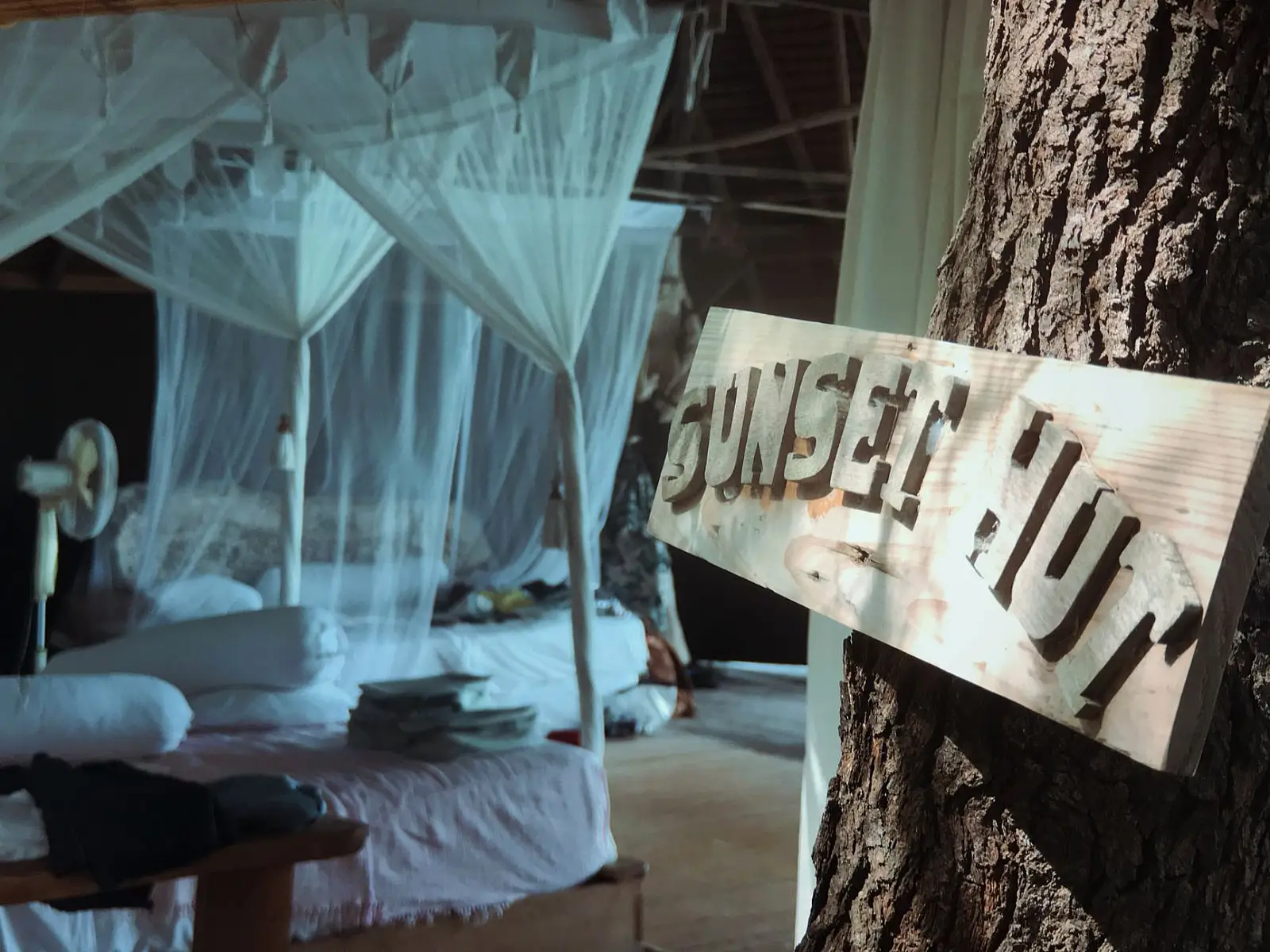
The measures official sources describe include EPA-registered repellents — CDC lists DEET, picaridin, IR3535, oil of lemon eucalyptus and 2-undecanone, and notes DEET efficacy "tends to peak at a concentration of approximately 50%" — along with permethrin-treated clothing, which CDC states "repels and kills ticks, chiggers, mosquitoes, and other biting and nuisance arthropods" at 0.5% concentration and should be applied 24–48 hours before packing. NaTHNaC adds loose long sleeves and long trousers, insecticide-treated bed nets, and that air conditioning reduces risk. One practical detail from NaTHNaC that people get backwards: apply sunscreen first and DEET after, and use a higher SPF because DEET reduces sunscreen's effectiveness.
What if I develop a fever after the trip?
This is the part of malaria guidance that matters most and gets the least attention. CDC states plainly that "malaria should be considered a potential medical emergency" and that "delay in diagnosis and treatment is a leading cause of death in malaria patients in the United States." Its guidance to clinicians is that "fever in a person who has recently traveled in a malaria-endemic area should always be immediately evaluated using the appropriate diagnostic tests for malaria."
NaTHNaC notes symptoms may appear between eight days and one year after an infected bite, and that people with malaria can deteriorate quickly. The practical implication drawn by both sources: if you develop a fever during or after travel to a malaria area, seek medical attention urgently and tell the clinician where you have been and when — including if you took preventive medication, because no prophylaxis is fully protective.