 SafariRoamer
Self-Drive Camping in Botswana's Parks: Who Runs the Camps, How to Book and What It Costs
Last reviewed 19 September 2026.
Botswana works differently from South Africa and Namibia
South Africa has SANParks and Namibia has NWR: one state operator that sells you a bed inside the park. Botswana has no single state camp operator. The Department of Wildlife and National Parks (DWNP) runs park entry, permits and fees, and operates some campsites itself. Other public campsites inside the parks are run by private companies, and you book and pay those with the company, not with the government. This guide covers the public, self-drive facilities in Chobe National Park, Moremi Game Reserve, the Central Kalahari Game Reserve, Makgadikgadi Pans National Park and Nxai Pan National Park. Private lodges and camps inside concessions are outside it. For the equivalents next door, see SANParks Rest Camps and Etosha and Sossusvlei NWR Camps; for when to travel, Best Time to Go on Safari in Botswana.
How this page was checked, and how much of it is official. The evidence for Botswana is thinner than for the other two countries, so each statement below says whose it is: a government source (the park regulations, a gov.bw page, the Botswana Tourism Organisation, the state news agency), the operator of the campsite talking about its own camps, or a non-official article. We could not open DWNP's own website (dwnp.gov.bw did not resolve and mewt.gov.bw timed out), and no government or DWNP document we found names the private operators: that comes from the operators' own sites and two travel articles. Where operators contradict themselves or each other, this page shows both.
Who runs which campsite
| Park and campsite | Run by | Sites and facilities as the operator states them | Careful |
|---|---|---|---|
| Chobe: Ihaha (riverfront) | Kwalate Safaris | 10 sites; shared flush-toilet ablution blocks, water standpipes, solar hot showers; no electricity; no firewood for sale; not fenced | We found no other public campsite on the Chobe riverfront in any official source |
| Chobe: Savuti | SKL Group of Camps | 14 campsites; ablution blocks with showers, communal braai areas, a standpipe, braai area and fireplace per site; not fenced | |
| Chobe: Linyanti | SKL Group of Camps | 5 campsites with ablution blocks with showers | |
| Moremi: South Gate (Maqwee) | Kwalate Safaris | 10 sites inside the gate; shared flush-toilet ablution blocks, standpipes, solar hot showers; no electricity | The operator says game can be seen in the campsite |
| Moremi: Xakanaxa | Kwalate Safaris | Basic shared flush-toilet ablution blocks, standpipes and solar showers; the operator's own pages give 8 sites on one page and 10 on another; not fenced | |
| Moremi: Third Bridge | Xomae Group | 10 sites, two ablution blocks and one standpipe | On 28 May 2026 the Moremi park manager said Third Bridge remained closed after the 2026 flooding (state news agency); we found nothing more recent, so check before planning |
| Moremi: Khwai and North Gate | SKL Group of Camps | SKL's own pages give 10 campsites on one page and 5 on another | |
| Khwai community area (outside the reserve): Magotho | Khwai Development Trust | 15 campsites | Run and booked by the trust, not by DWNP or the three park operators |
| Central Kalahari | Bigfoot Tours for Piper Pan, Sunday Pan, Passarge and others; DWNP for Deception Valley and others | Basic: pit latrine, bucket shower, borehole water at the main entrance gate; no fuel, electricity or ATM; up to 6 people and 3 vehicles per site; no fences | Sources disagree on which camps each runs (Bigfoot 2021, Tracks4Africa 2022, Getaway 2023) |
| Makgadikgadi Pans: Khumaga | SKL Group of Camps | 10 sites and two ablution blocks | DWNP is reported to run Tree Island, and per one article Njuca Hills |
| Nxai Pan: South Camp | Xomae Group | 10 sites, two ablution blocks, two standpipes, an artificial waterhole | |
| Nxai Pan: Baines Baobab | Xomae Group | 3 sites; the operator says "no water" |
None of the site counts or facilities above is described by a government source, and no independent source confirms Savuti's 14 sites, Ihaha's 10 or Third Bridge's. One SKL page for Khumaga names the wrong reserve. The Botswana Tourism Organisation calls Moremi a top self-drive camping destination and names the Third Bridge campsite, but gives no details.
How to book
Book first, with the right party. The park regulations require a reservation voucher from a DWNP-designated reservations office for any overnight use of a public camp ground, every visitor needs an entry permit and must register at the gate, and entry can be restricted to holders of valid reservations. In practice, campsites run by a private operator are booked and paid with that operator; DWNP separately issues the entry permit and invoices the park and vehicle fees once the operator has sent it the voucher. Only campsites that DWNP itself operates, such as some in the Central Kalahari, are booked directly with DWNP by email or telephone. We found no DWNP online booking or payment system: the only official gov.bw booking page describes a request form (fax, post, email or in person) for groups, travel agencies and tour operators, confirmed by an invoice for the full amount within three working days.
| Company or office | Camps | How to book | Published terms |
|---|---|---|---|
| Kwalate Safaris | Ihaha, South Gate, Xakanaxa | Email kwalatesafari@gmail.com or customercare.kwalate@gmail.com; telephone +267 686 5551; online payment page (credit card or EFT, in Pula) | Bookings open 12 months ahead, peak season April to October. 50% deposit, balance due 3 weeks before arrival, or in full at once if booked within 3 weeks. Refunds on fully paid bookings: 50% up to 4 weeks before, 30% from 4 to 1 weeks, none under 1 week. Amendments up to 14 days before check-in cost BWP 300; reinstating a forfeited booking within 7 days costs BWP 500. Government levies and DWNP park fees are not refunded |
| SKL Group of Camps | Savuti, Linyanti, Khwai and North Gate, Khumaga | Online booking calendar at sklcamps.com; email reservations@sklcamps.co.bw; telephone +267 686 5365 or 686 5366 | Provisional bookings are held two weeks. Its terms page gives two confirmation amounts, a 20% commitment fee and a 30% non-refundable deposit. Final payment 60 days before travel. Cancellation: 61 days or more, forfeit 30%; 60 to 46 days, 50%; 45 days or fewer, 100%. Reservations must be claimed by noon on the arrival date; check-out is 10:00 |
| Xomae Group | Third Bridge, Nxai South Camp, Baines Baobab | Online booking form; email reservations@xomaecamps.co.bw or bookings@xomaesites.com; telephone 686 22 21 or 686 22 62 | A tax invoice is emailed, then paid online. Cancellation table as published: "2 months prior to travelling dates 75% of the total costs; a month prior 50% of the total costs; less than a month - no refund". The wording does not say whether those percentages are penalties or refunds |
| Bigfoot Tours | Central Kalahari and Khutse | Email reservations@bigfoottours.co.bw; telephone +267 3953360 (2024 capture of its about page) or +267 73 555 573 (2021 capture) | No terms found |
| Khwai Development Trust | Magotho | Email reservations@khwaitrust.co.bw; telephone +267 6862361 | No terms found |
| DWNP | Camps DWNP runs itself | Email dwnp@gov.bw; Maun reservations office +267 686 1265, Gaborone +267 318 0774. The Maun reservations office lists 07:30 to 12:45 and 12:45 to 16:30 Monday to Saturday and 07:30 to 12:00 on Sundays | No published terms found |
The terms conflict with the regulations. The park regulations say fees for overnight facilities must be paid in full within 30 days of the reservation or the reservation lapses, and that they are not refunded even if the facility goes unused. The operators' partial refunds contradict that. Phone numbers for Kwalate differ between its own site and press articles; the email addresses are the safer route. Whatever you book, ask for the terms in writing.
Gates, driving and camp rules
The only official rules text we could read is the National Parks and Game Reserves Regulations, in a copy dated 1 April 2000; check that no later amendment has replaced any of this. We found no park-specific gate times.
- Gate hours: from 1 April to 30 September the gates open at 06:00 and close at 18:30; from 1 October to 31 March they open at 05:30 and close at 19:00.
- Night: nobody may enter a park or move outside a designated campsite between sunset and sunrise, and driving in that period is prohibited. Night drives are allowed only with a licensed professional guide in a designated area, back at the camp by 22:00.
- Speed and roads: 40 km/h in the parks and 80 km/h on a designated tarred transit road. Driving off designated roads and tracks is prohibited.
- Staying in the vehicle: you may get out only with a clear view and no dangerous animal within 100 metres, and never more than 25 metres from the vehicle.
- The vehicle: the tourism board says camping trips go to remote areas "accessible only by four-wheel drive", and SKL says its campsites are reached by a 4x4 self-drive vehicle. A two-wheel-drive vehicle is banned on roads signed for four-wheel drive only without written authorisation from the Officer-in-Charge. We found no official high-clearance rule.
- Be self-sufficient: the tourism board advises at least 20 litres of water per person (50 to 100 litres for desert destinations), at least 100 litres of petrol, all your food, and a spare wheel and parts.
In camp
- Camping is allowed only in designated campsites, and you must sleep inside a tent, a roof tent or the vehicle.
- Firearms are prohibited; a sealed firearm in transit needs written authorisation. Pets are not allowed without the Director's written permission. Feeding wild animals is prohibited.
- SKL adds: no more than three vehicles per site, no generators, no quad bikes or motorcycles, and no drones at any of its camps. We found no DWNP rule that names drones.
- Quiet hours differ by operator: SKL 18:00 to 06:00, Bigfoot 20:00 to 06:00.
- Firewood: the regulations allow gathering dead and fallen wood along roads, but not within 1 km of a designated facility and not where a notice at the entry point prohibits it. SKL prohibits collecting wood at its camps. Ask at the gate.
Wildlife and unfenced camps
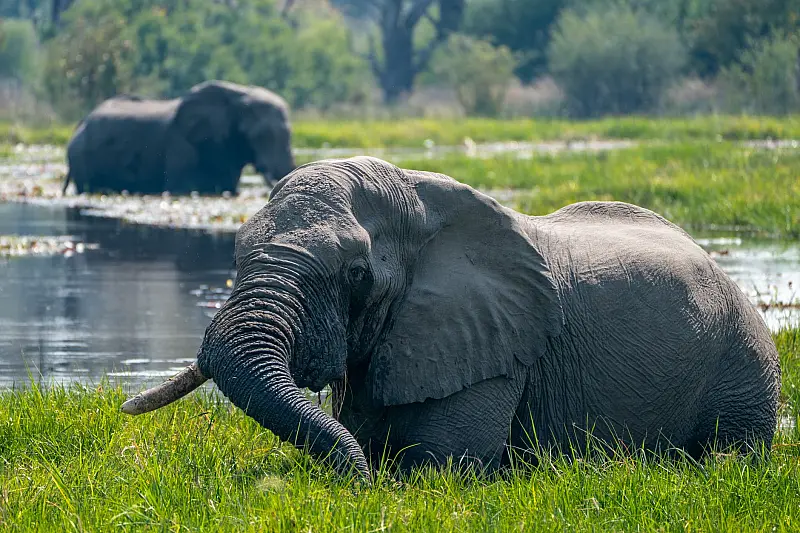
The Botswana Tourism Organisation states that campsites in game reserves and national parks are usually not fenced, tells campers to camp only in designated campsites, sleep in a tent, roof tent or vehicle and not walk in the bush unless with a qualified guide. Kwalate, SKL and Bigfoot each say their own sites are unfenced, and SKL says visitors enter the parks at their own risk. We found no official statement about wildlife danger specific to a particular camp.
Foot-and-mouth restrictions
In 2026 the Ministry of Lands and Agriculture imposed and revised foot-and-mouth movement restrictions by numbered disease-control zone. A notice of 18 February 2026 says fresh products may not be moved out of Zones 3b, 3c, 6a, 6b and 7, and a notice of 5 May 2026 says restrictions are maintained in Zones 11, 12 and 13 and that fresh products may not leave the containment zone. The notices name zone numbers only, and none maps them to park access roads; we found no official September 2026 notice. The Botswana Tourism Organisation advises tourists not to import meat or dairy products and says the rules change with outbreaks. Ask at the checkpoints you pass.
Park fees
Park entry, vehicle and camping fees are paid to DWNP, not to the campsite operator. Each calendar day of entry, residence or facility use counts as a full day, even if you are in the park for part of it, so a stay of n nights is charged n plus 1 days of entry fees.
The last schedule we could read is from 2022
Fees are set in the First Schedule to the National Parks and Game Reserves Regulations, as amended by Statutory Instrument No. 3 of 2021, in force from 1 April 2022, in Pula. We found no official current fee page and no copy of the instrument in the government gazette: we read the schedule from two tour-operator copies of it, which are not independent of each other. It carries no tariff year and no expiry date.
| Parks | Citizen | Resident or SADC national | Non-resident |
|---|---|---|---|
| Category A: Chobe National Park and Moremi Game Reserve | P30 | P205 | P270 |
| Category B: all other parks and reserves, including the Central Kalahari, Makgadikgadi Pans and Nxai Pan | P20 | P145 | P190 |
| Where | Botswana-registered | Foreign-registered |
|---|---|---|
| Chobe National Park | P30 | P115 |
| All other parks, including Moremi Game Reserve | P20 | P75 |
Children under 8 pay nothing and children from 8 to 18 pay half under DWNP's fee notes, but sources disagree on the upper age (one operator page says 8 to 17, others 8 to 15). A lower entry rate applies to "Clients of Botswana Tour Operators"; our reading, not an official statement, is that a self-drive visitor who books a campsite directly is a private visitor, so the rates above apply. The schedule also lists a camping fee per person per night, P20, P45 and P60 in Category A and P15, P30 and P40 in Category B, by the same three visitor categories. Campsite operators quote their own nightly rates as well, and we found no current published rate table for them and could not establish how the two relate, so ask the operator for the all-in nightly price. The regulations deem overnight fees to include any sales tax; whether entry and vehicle fees include VAT is not stated.
A 2026 revision was announced, and we cannot tell whether it applies
On 24 February 2026 the Minister of Environment and Tourism presented proposed higher park fees at a consultative meeting, and the state news agency reported that some agreed fees would start on 1 April 2026 while others needed a regulation amendment first. The article gives the proposals as citizen entry from P30 to P50 and non-resident entry from P380 to P500. Neither the P380 baseline nor the rise matches the schedule above (non-resident entry is P270 in Category A and P190 in Category B), which is one more reason not to quote those numbers. Media then reported that the increase was postponed on 31 March 2026, one radio report saying by two years, but we found no Ministry document saying so, and one operator page dated 13 April 2026 says the new fees took effect. Pages from 2026 still show the 2022 amounts. Treat the 2022 figures as the last schedule we could read, expect a rise, and confirm the amount with DWNP before you travel.
Fees are paid to a wildlife officer. An older DWNP document says gate payments may be made in Pula, South African rand, US dollar or British pound notes. Operator pages, which are not official, say that entry fees are paid in cash at the gate or in advance at the DWNP office in Maun, and that "There are card machines, but it does not always work." Carry cash.
Health: malaria
The sources give different malaria seasons for northern Botswana: the Botswana Tourism Organisation says November to April in the Okavango and Chobe areas, the Ministry of Health October to May, the UK's TravelHealthPro high risk from October to May, and a 2018 WHO statement November to May or June. The CDC lists districts with transmission, including Chobe (with Chobe National Park), Ngamiland and Okavango, Boteti and Ghanzi, and recommends preventive medication for them. The sources name districts, not parks, and none names the Central Kalahari; we do not map parks to districts here. Botswana had a malaria upsurge in the 2024 to 2025 season, with 1,688 cases and 8 deaths reported by 1 April 2025. A yellow fever certificate is required only if you arrive from a country with yellow fever risk. This is a summary of what official sources say, not medical advice: see Malaria on Safari: What Official Guidance Says and Safari Safety: Wildlife, Vehicles and Camps.
What we could not verify
- Any official current fee schedule, the original government gazette text, whether the 2026 revision applies, whether entry and vehicle fees include VAT, the child age limit, and how a hired vehicle is classified for the foreign-registered rate.
- Any government document that names the campsite operators, or describes site counts, facilities or fencing at their camps, and which Central Kalahari and Makgadikgadi camps DWNP runs itself.
- Independent confirmation of the site counts, and the current status of Third Bridge and the Moremi roads after the 2026 floods.
- Park-specific gate times, a high-clearance vehicle rule, DWNP terms for its own camps, and any rule on whether gate staff need a printed booking confirmation.
- Whether the regulations we could read (2000) have been amended, and which of the conflicting operator and regulation terms applies to a given booking.
- Where foot-and-mouth zones fall on the roads to the parks, and any official notice after 5 May 2026.