 SafariRoamer
Drones and Photography Rules in Safari Parks: What Authorities Publish
Last reviewed 2 November 2026.
This guide reports only what park, civil aviation and customs authorities publish on their own pages, all read on 2 November 2026. It is general information, not legal advice. Where documents are undated or contradict each other, we say so; countries with no official page we could read are listed at the end.
Can you take a drone on safari?
Wherever an official page exists, bringing a drone is a permit process, and flying it inside a national park is either prohibited or allowed only with a separate park-level permission. Two approvals are normally involved: the civil aviation authority (import, registration, operation) and whoever manages the park. Holding the first does not give you the second. Rules for people are in our visa and entry requirements guide.
South Africa: SANParks and Kruger
A SANParks media release dated 20 February 2018 says flying drones "is not permitted in any National Park irrespective of what the purpose may be" and warns that offenders "will be arrested on the spot and their equipment will be confiscated". A SANParks article of 31 August 2023 gives the legal basis: flying below 2,500 feet above a park's highest point without the managing authority's permission is illegal. SANParks' news page also lists a "Reminder on the use of drones in the Kruger National Park" dated 3 July 2025; we could read only its headline.
One nuance: SANParks' fee schedule for 1 November 2025 to 31 October 2026 lists a "Drone / RPAS Fee (Per Day)" of R14,790 among filming charges, and its Table Mountain events guidance says limited locations "may be considered" under a park drone flight process. That points to permitted film productions, not holidaymakers. Camp rules are in our SANParks rest camps guide.
Tanzania: TCAA, TANAPA and Ngorongoro
The TCAA says a non-resident travelling with a drone must obtain an import permit ("without TCAA import permit, the drone will be confiscated at the entry point upon arrival"), register the drone and the pilot, and apply for an operations permit, all at least three weeks before arrival, with no refund if not completed in time. We could not read a fee schedule.
TANAPA publishes two undated drone documents that do not agree. One says no one may use a drone in a park without permits from the Filming Board, the Ministry of Defence, the TCAA and the Conservation Commissioner, sets a minimum height of 50 metres, bans drones during the Serengeti crossings and gives a penalty of not less than TZS 100,000 (or US$100) plus confiscation. The other says drones are "only allowed for authorized Resource Protection, Research and Training purposes", at 100 to 120 metres, with permits valid for 30 days. We cannot tell which is current. TANAPA's trip-planning page says drone use "is restricted and requires special permissions". Park fees are in our Tanzania national park fees page.
The Ngorongoro authority says commercial filming needs a permit and that photographing local people is prohibited except in designated Cultural Bomas. Its pages do not mention drones.
Kenya: KCAA and KWS
Kenya's Unmanned Aircraft Systems Regulations, 2020 bar importing a drone without a KCAA permit, issued after defence-ministry clearance, and allow a temporary permit of up to 30 days, renewable once. KCAA's manual (November 2020) says a drone imported temporarily for private use must not be used for reward or gain, "including development of content aimed at publication for personal gain". The fee schedule gazetted on 22 January 2021 lists KSh 3,000 for an import permit and KSh 20,000 for a temporary permit; it is old, so confirm current charges.
The KWS schedule headed "Conservation Fees 2025" lists "Drone charges (KCAA licenses required)" per drone, per day, per park: KSh 5,000 for East African citizens and US$300 for non-residents. That implies drones can be authorised in KWS areas, but we could not read the process because the KWS permits portal did not load.
Uganda and Rwanda: drones
Uganda's advisory circular (July 2020) splits the process in two: import is cleared through customs, the UCAA and the Chief of Defence Forces; operation then needs a ministry no-objection letter, security clearance and an authorisation fee of UGX 250,000 plus 18% VAT. The UWA tariff (July 2024 to June 2026) charges filming with a drone at 50% of the activity fee, against 40% for ordinary filming. We found no UWA text setting park flight rules.
Rwanda's aviation authority says to "declare your drone to Rwanda National Police at any point of entry" and requires an activity permit before flying. Visit Rwanda says processing takes about two to four weeks and that foreign citizens cannot register drones themselves: a Rwandan citizen, permanent resident or entity must do it for them. We found no RDB page on drones in parks.
Botswana, Namibia and Zimbabwe
Botswana's Remotely Piloted Aircraft Regulations, 2024 let only a citizen, lawful resident, Botswana company or the government own such a system, and allow imports only from a CAAB-authorised supplier. Read together, a visitor fits none of the owner categories; we found no official page on how tourists bring one in, so ask the CAAB first. The 2019 Filming Guidelines treat drone requests "case-by-case", require a DWNP supplementary permit for parks and bar out-of-vehicle filming in protected areas without the Director's permission. See our Botswana self-drive guide.
Namibia's civil aviation authority says foreigners must apply at least 60 days before arrival, all flights need written approval and "flying in National Parks is strictly prohibited". The environment ministry's release of 25 February 2025 says drones are "not allowed in Namibia's National Parks without an official permit" and must be declared at park gates. The wordings differ; treat park flying as off the table without written ministry permission. See our Etosha and Sossusvlei guide.
In Zimbabwe, the revenue authority's undated page says importing a drone needs a CAAZ clearance letter and that drones must be declared at entry.
Flash, distance and gorilla photography
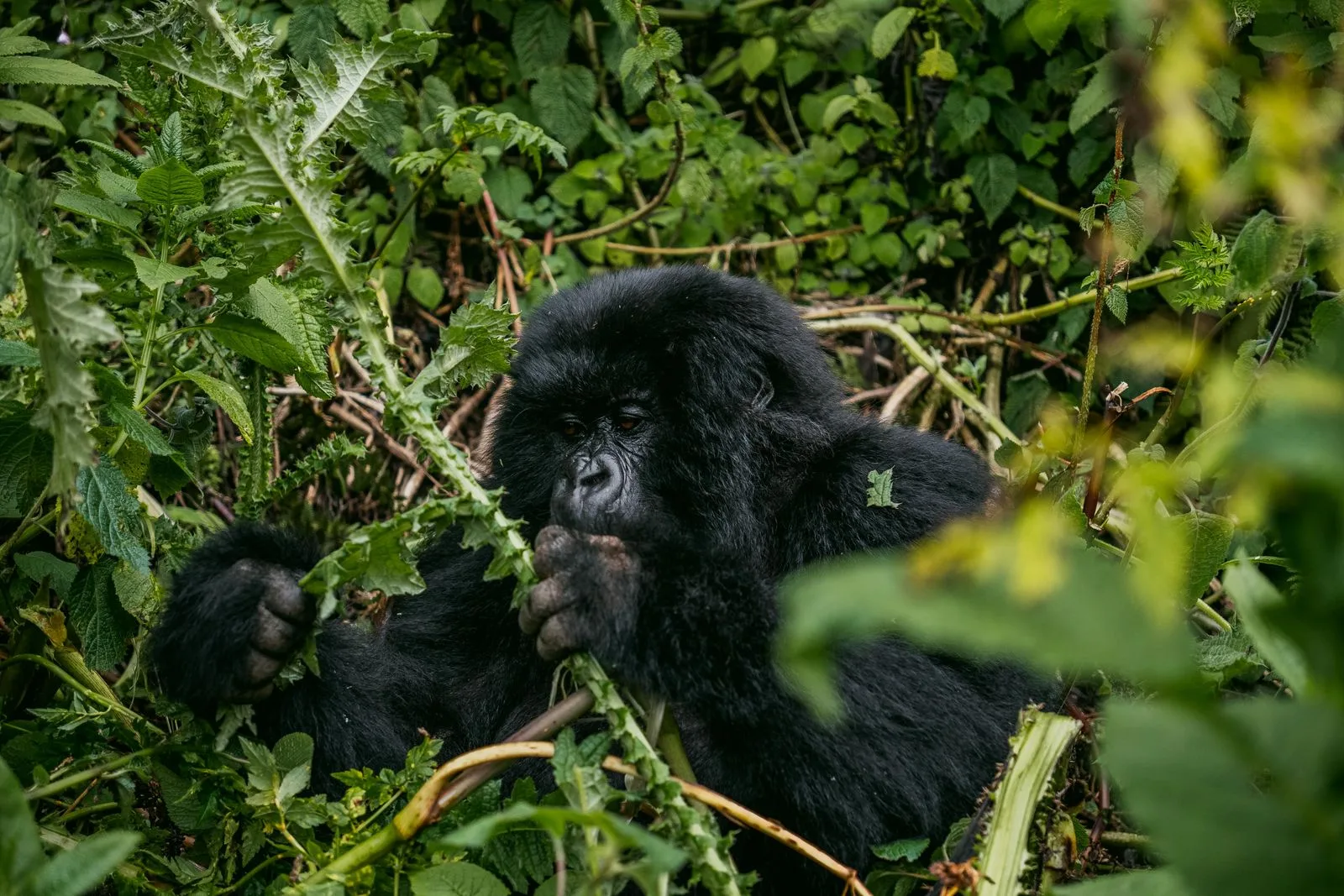
The UWA tariff for July 2024 to June 2026 (that period has ended and we found no newer edition) sets 10 metres from gorillas, no flash, one hour, eight visitors per group and a minimum age of 15; chimpanzees also 10 metres and no flash. Rwanda's RDB booking page asks for 7 metres "to minimize possible transmission of human diseases" and says "photographs are permitted, although you may not use flash". The two authorities publish different distances, so follow your guide. See Rwanda vs Uganda gorilla trekking, and the Uganda and Rwanda permit pages.
KWS pages for Nairobi and Amboseli say to view wildlife "from a minimum distance of 20 meters". We found no official figure elsewhere; our safety guide notes the same gap for elephants.
Commercial photography and filming
SANParks' terms say commercial filming or photography, "either directly or indirectly", is unlawful without a filming permit; its 2025/26 schedule lists an application fee of R451. TANAPA's terms use the same wording. Botswana treats any photography for which the photographer is paid as commercial, with 30 working days for processing. No page we read says whether a monetised social account counts, so ask the park first.
What we could not verify
- Zambia: no official aviation or park page on drones was reachable, so it is dropped.
- Tanzania: any TCAA fee schedule; which TANAPA document is current.
- Kenya: the KWS authorisation process and current KCAA fees.
- Rwanda and Zimbabwe: any park rule on drones.
- Kruger: the text of the July 2025 SANParks reminder.
Sources
- SANParks: media release, 20 February 2018 (read from an archived copy of the page); Scientific Services article, 31 August 2023; Events, Filming and Photography fee schedule 2025/26; Terms and Conditions; Table Mountain filming page.
- Tanzania Civil Aviation Authority, Drones page (undated); TANAPA drone guidelines (two undated documents), Terms and Conditions, Plan a Trip; Ngorongoro Conservation Area Authority, Visitor Guidelines.
- Kenya: Unmanned Aircraft Systems Regulations 2020; KCAA Manual of Implementing Standards, November 2020; Gazette Supplement No. 5, 22 January 2021; KWS Conservation Fees 2025; KWS Nairobi and Amboseli pages.
- Uganda Civil Aviation Authority, Advisory Circular UCAA-AC-UAS001, July 2020; Uganda Wildlife Authority, Conservation Tariff July 2024 to June 2026.
- Rwanda Civil Aviation Authority, Unmanned Aircraft pages; Visit Rwanda, Drones; RDB, Mountain gorilla tracking page.
- Civil Aviation Authority of Botswana, drone registration page; Remotely Piloted Aircraft Regulations 2024; Botswana Filming Guidelines 2019.
- Namibia Civil Aviation Authority home page; Ministry of Environment, Forestry and Tourism press release, 25 February 2025.
- Zimbabwe Revenue Authority, "Importation of drones" (undated).