Great Migration Month by Month: Where the Herds Actually Are
Last reviewed: September 2026. All timings below describe what happens in a typical year. They are not predictions, and no source can tell you the date of a future river crossing.
Almost every migration calendar online presents the same neat circle: herds in the south in February, the Western Corridor in June, the Mara in August, back south by November. The shape is roughly right. The problem is the confidence. The wildebeest are not following a route — they are following grass, and grass follows rain. In years when the rain arrives early, late, or in the wrong place, the whole sequence shifts by weeks.
Why isn't the Great Migration a fixed calendar?
The Serengeti–Mara ecosystem has a rainfall gradient running from the dry southeastern plains (roughly 400 mm a year) up to the wetter northwestern woodlands near the Kenyan border (up to about 1,200 mm), described in Holdo et al. (2011). Opposing that is a nutrient gradient: the volcanic short-grass plains in the southeast produce grass that is low in bulk but exceptionally high in protein and minerals.
Modelling work in The American Naturalist (Holdo, Holt & Fryxell, 2009) found that the models best explaining observed monthly wildebeest distributions were those combining green-grass intake rate with nitrogen concentration — in other words, the herds behave as if they are balancing how much they can eat against how good it is. Earlier satellite work modelled the same movements from rainfall and new vegetation growth directly.
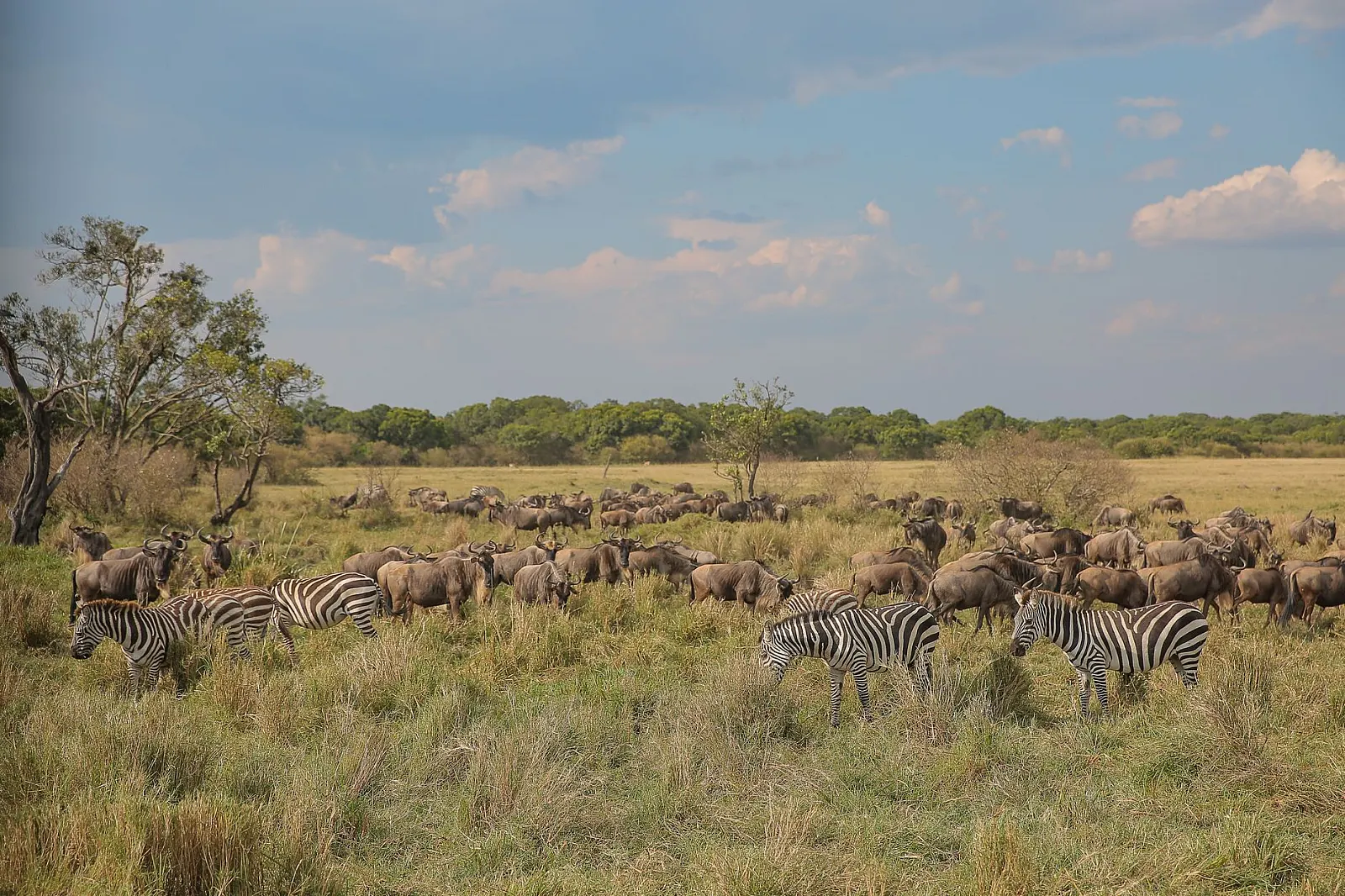
So the herds sit on the nutrient-rich southern plains while the rains keep those plains green, then move northwest when the plains dry out, because the north holds the last green forage even though its quality is lower. That is the engine. Everything in the table below is a downstream consequence of it — which is exactly why the dates move.
Where are the wildebeest each month?
| Month | Where the herds typically are | What's happening | Where to be based |
|---|---|---|---|
| December | Arriving on the southern short-grass plains and Ndutu, after the short rains | Herds concentrating; earliest calves appear in some years | Ndutu, Kusini, southern Serengeti |
| January | Southern plains and Ndutu, shifting locally with rain | Calving usually beginning; highly rain-dependent | Ndutu / Ngorongoro Conservation Area plains |
| February | Ndutu and the southeastern plains | Calving peak in most years; predator activity at its highest | Ndutu, Kusini |
| March | Southern plains, beginning to loosen as the long rains set in | Late calves; herds start dispersing | Ndutu, southern and central Serengeti |
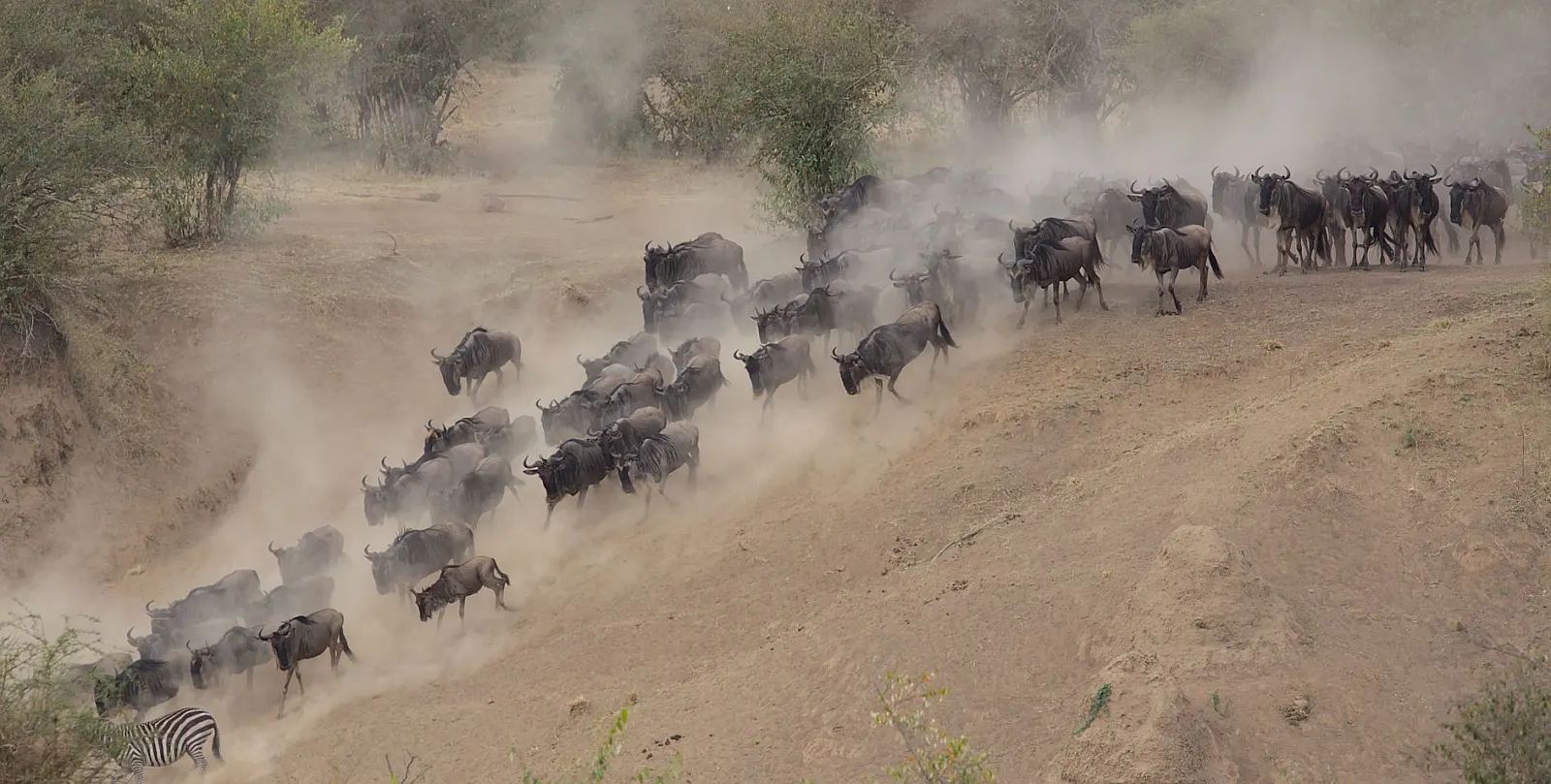
| April | Drifting northwest through central Serengeti (Moru, Seronera) | Long rains; herds form columns; quietest tourist season | Central Serengeti |
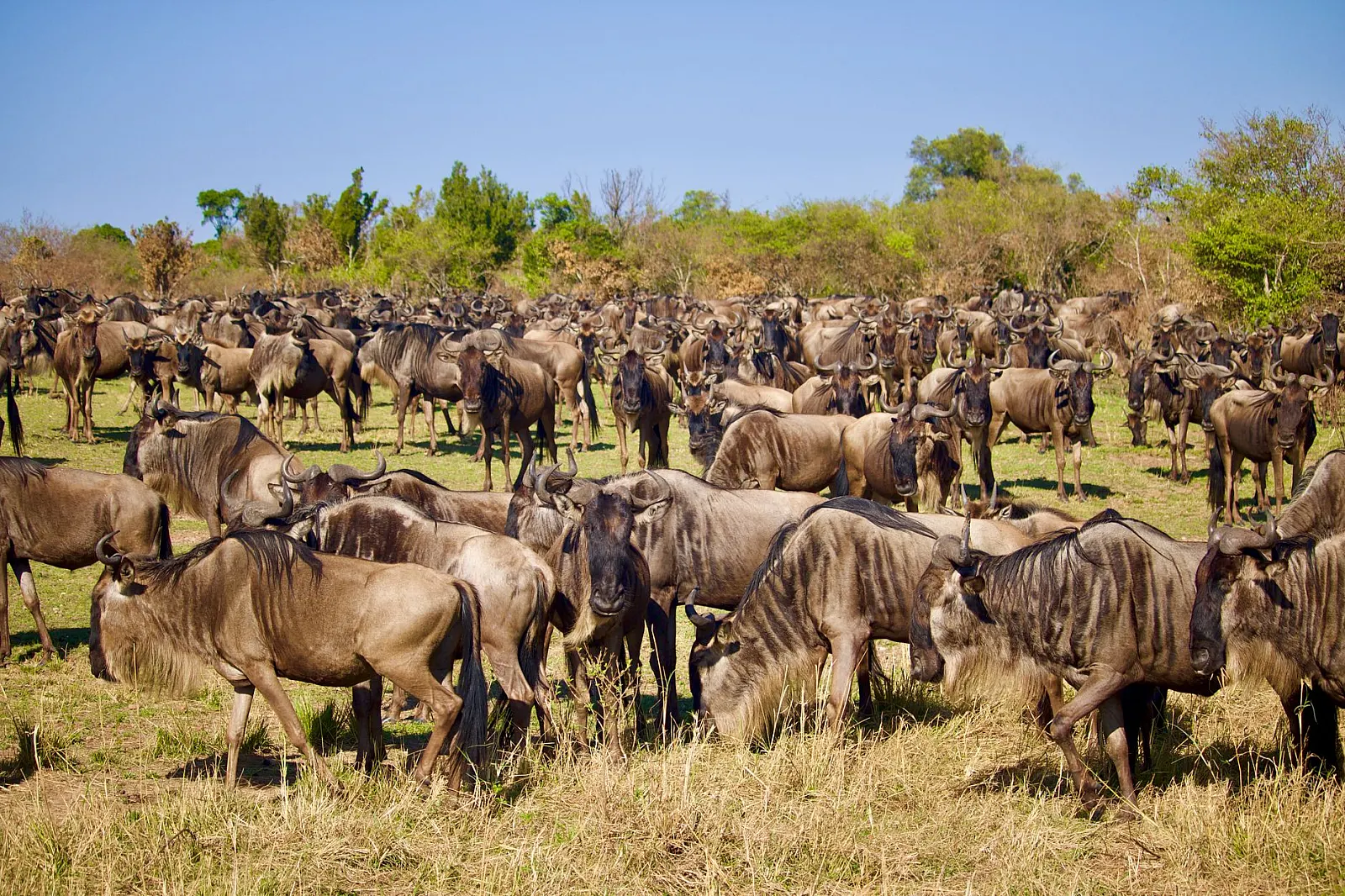
| May | Central Serengeti into the Western Corridor | Rut typically peaks; long marching columns | Central Serengeti / Western Corridor |
| June | Western Corridor and Grumeti River; front-runners pushing north | Grumeti crossings possible; dry season begins | Western Corridor, Grumeti |
| July | Northern Serengeti (Kogatende, Lamai); arriving at the Mara River | First Mara crossings in most years | Northern Serengeti |
| August | Split across the border: northern Serengeti and Masai Mara | Peak Mara crossing activity in most years | Northern Serengeti and/or Masai Mara |
| September | Northern Serengeti and Masai Mara; herds fragmented | Crossings continue, in both directions | Either side of the river |
| October | Mara and northern Serengeti; southward drift begins | Return crossings; entirely rain-dependent | Northern Serengeti / Masai Mara |
| November | Moving south via Loliondo and Lobo toward the plains | Short rains pull the herds back south | Northern to central Serengeti, later Ndutu |
When is the Ndutu calving season, and why does it happen there?
Calving runs broadly from late January into March, with the peak most often in February. The window is narrow because wildebeest breeding is unusually synchronised. Research published in PNAS on rutting-call-induced ovulation notes that historically around 80% of females mate within a two- to three-week window at the peak of the rut, and estimates gestation at roughly 258 days (range 242–274). Push a May–June rut forward by about eight and a half months and you land in late January to February.
Ndutu itself is not in Serengeti National Park — it sits in the Ngorongoro Conservation Area, on short-grass plains enriched by volcanic ash from the Ngorongoro highlands. That ash gives the grass the calcium, phosphorus and protein that lactating females need, and the short sward means predators can be seen coming. It is a nursery chosen for chemistry and sightlines, not tradition.
And it moves. The same source records a season in which the first calves appeared as early as 28 December, which it attributes to rainfall patterns shifting the rut. If the short rains fail on the southeastern plains, the herds may calve further west or north than usual. Book Ndutu in February by all means — just understand you are booking a probability, not a certainty.
Grumeti or Mara — which river crossing happens when?
These are two different rivers, in two different countries' worth of landscape, months apart, and they are constantly conflated.
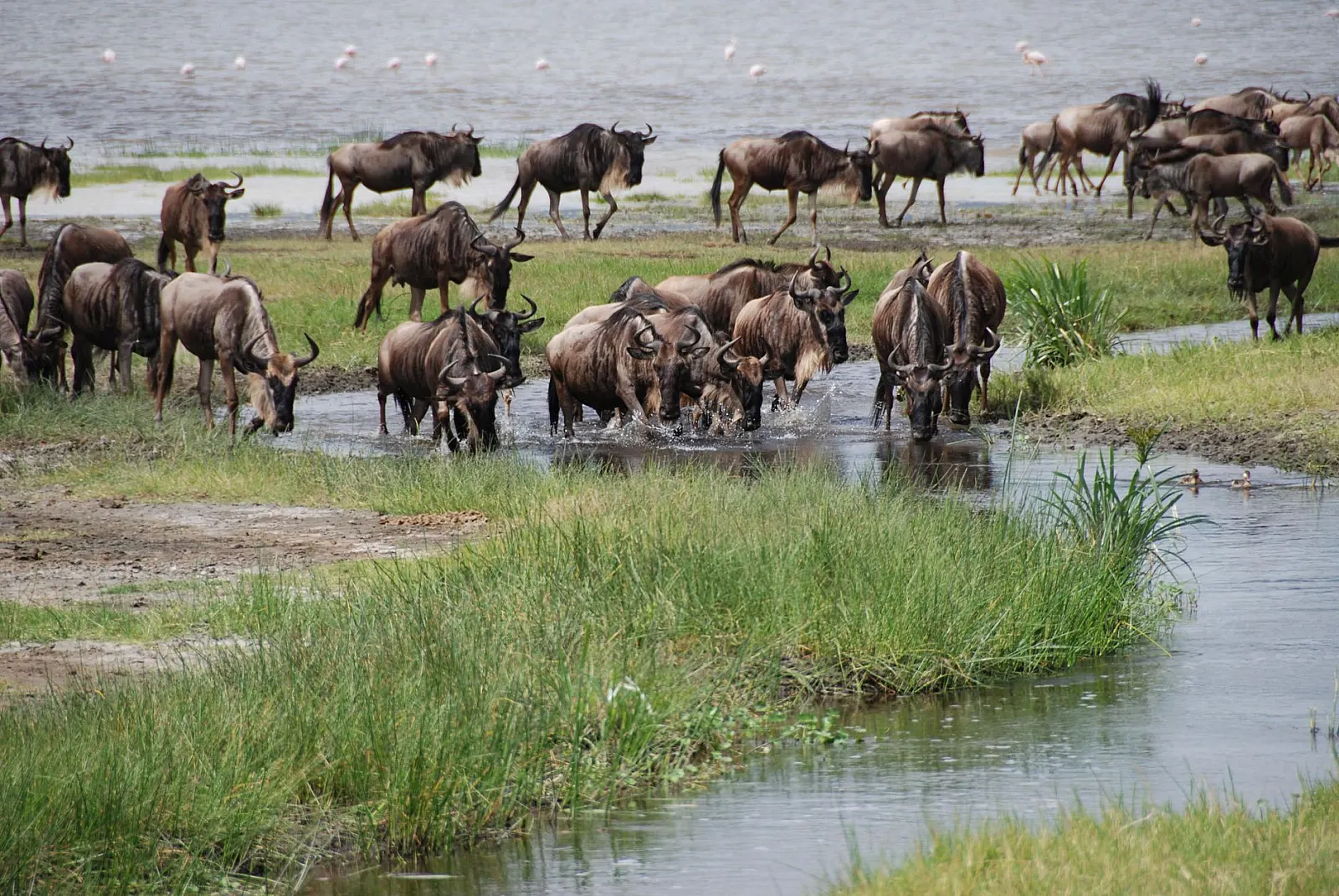
- The Grumeti River runs through the Western Corridor of the Serengeti. Herds typically reach it around late May to July. It is often a series of disconnected pools rather than a continuously flowing river, so crossings tend to be smaller and more fragmented — fewer vehicles, less spectacle, enormous Nile crocodiles.
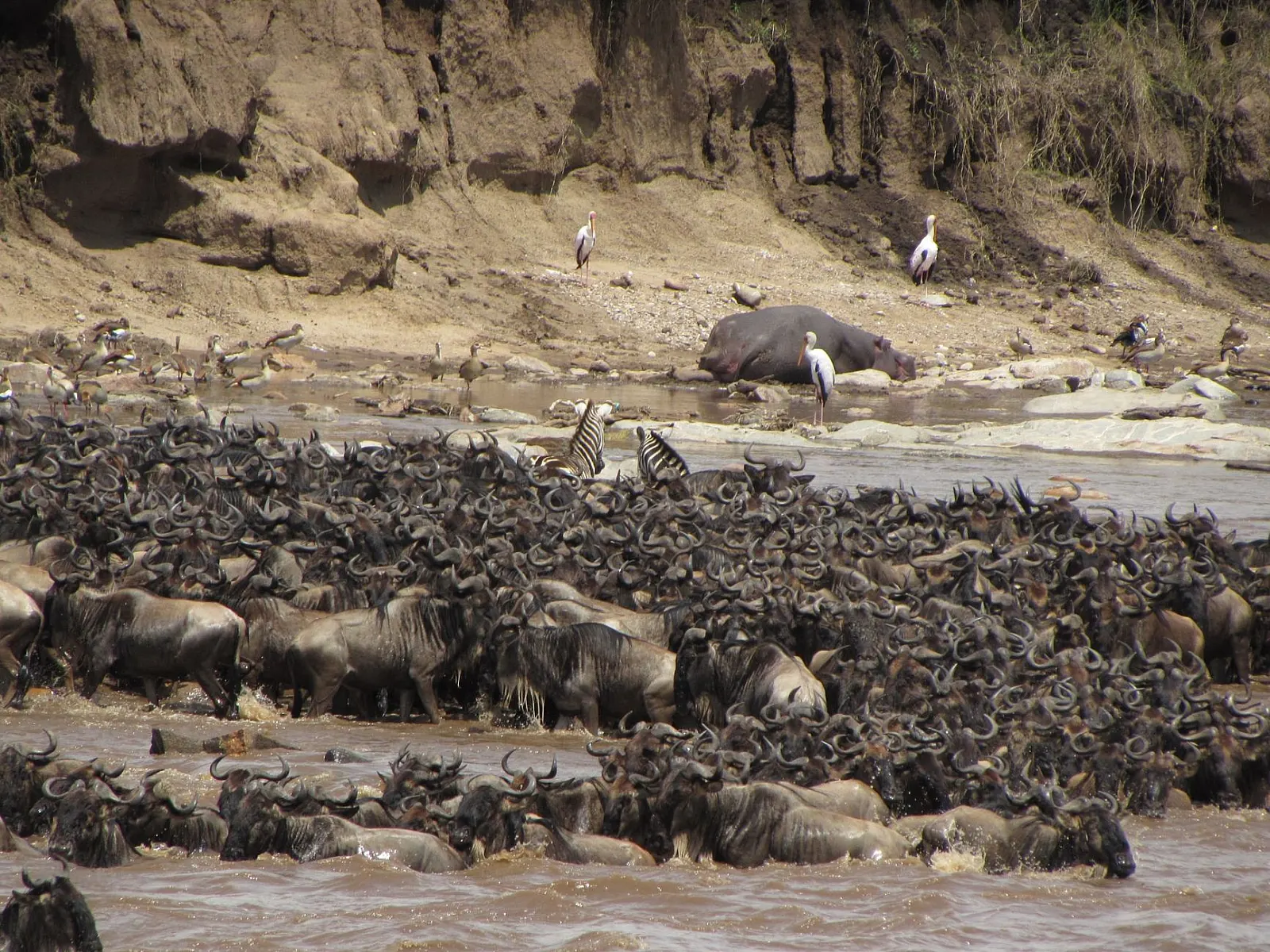
- The Mara River runs through the northern Serengeti and the Masai Mara. Herds typically reach it from July, with the heaviest activity July–October. It is permanent, fast-flowing, with steep banks. This is the river in every documentary.
If someone sells you "the river crossing" in June, ask which river.
Why can't you book a river crossing for a specific date?
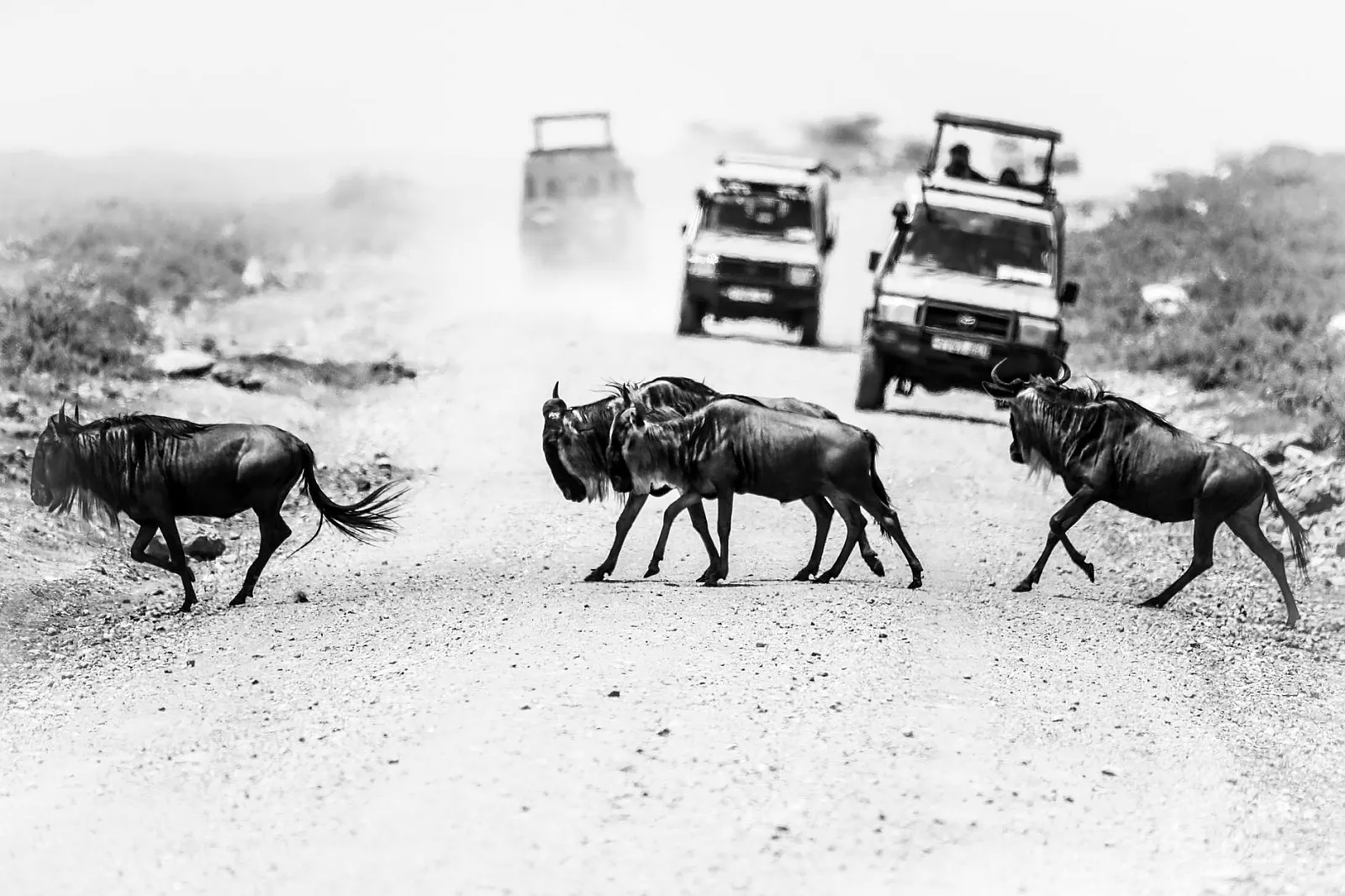
Because the herd decides, on the day, for reasons that are partly invisible. A crossing requires several things to line up at once: enough animals pressed against the bank, a usable descent and exit, river level, and one animal willing to go first. Herds routinely gather for hours, walk to the edge, turn back, move to a different site, and cross unannounced the next morning — or recross back the way they came days later. Crossings are not one-way.
Whole-season anomalies happen too. Serengeti National Park's own migration overview states plainly that "the timings outlined on this page concern guidelines as exceptions occur frequently," citing 2013, when unexpected rains reversed the herds for three weeks, and 2014, when freak southern rains delayed the northbound move until July. Africa Geographic puts it more briefly: "rainfall drives the event, so tracking the herds is not an exact science."
How many days should you budget near a crossing point?
Here is the only hard number we have found. In a five-year study on the Kenyan reach of the Mara River, published in PNAS (Subalusky et al., 2017), researchers recorded wildebeest river crossings on 52 ± 16 days per year, during a migration residency in the region averaging 172 ± 45 days. Those crossings were distributed across 12 major crossing sites.
Read that honestly: during the season, something crossed somewhere on roughly a third of days — and you can only watch one site at a time. That is the real base rate. It is why operators who track this properly advise staying put: "stay in the same spot for a few solid days at a time, rather than hopping from one lodge to the next."
Practical guidance: one night near the Mara River is a lottery ticket. Two nights is optimistic. Three to four nights within reach of the Kogatende–Lamai crossing sites (or the Mara Triangle on the Kenyan side) during late July to early October gives you a realistic chance. Five gives you a good one. Nobody can offer better than that, and anyone quoting you a date is guessing.
How many wildebeest are there, actually?
Worth knowing, because the headline number is under revision. The long-cited figure of 1.2–1.3 million dates from 1970s aerial sampling. A 2025 AI-based satellite survey of August 2022 and 2023, covering over 4,000 km² of the northern Serengeti and Masai Mara, estimated roughly 500,000–530,000 animals in the surveyed area. The authors are careful: this does not invalidate the older method, and the survey area was not the whole ecosystem. But treat "1.5 million wildebeest" in marketing copy as folklore, not data.
The short version
- Want newborn calves and predators: Ndutu / southern plains, late January to early March, peak usually February.
- Want Mara River crossings: northern Serengeti or Masai Mara, late July to early October, minimum three nights in one place.
- Want Grumeti, quieter and smaller: Western Corridor, late May to July.
- Want huge herds with no crowds: central Serengeti in April–May, and accept the rain.
- In every case: the herds are where the grass is, and the grass is where the rain was.